

On this page
There is no age limit for straight teeth. Many of our patients only start orthodontic treatment as adults – some because they have long been unhappy with their smile, others because their dentist has identified a misalignment as the cause of problems with their gums, jaw joints or dental restorations. At our practice in Singen, Dr. M.Sc. M.Sc. Martin Jaroch, Master of Science in orthodontics and in periodontology and implant therapy, plans braces for adults with the whole mouth in mind.
Why adults choose braces
Aesthetics: crooked front teeth, gaps or crowding are noticeable when you talk and laugh. Braces can make your smile more harmonious without grinding down healthy tooth structure.
Function: crowded teeth are harder to clean, and plaque stays on them longer. A poor bite can strain the gums and jaw joints.
Preparing for dental restorations: when teeth have tipped or drifted into a gap, there is often not enough room for a crown, a bridge or an implant. Orthodontic pre-treatment creates the right conditions.
Relapse after earlier braces: many people who wore braces as teenagers find their front teeth shifting again years later – for example because they stopped wearing a retainer. Relapse like this can be treated too.
The foundation first: gums and bone
In adults, teeth move in bone that is no longer growing, and sometimes the gums have already receded. That is why we start with a thorough examination of the tissues supporting the teeth. If periodontitis is present, it is treated before the braces – read more under Periodontology and Invisalign® for gum recession and periodontitis.
If teeth are missing or implants are planned, we coordinate the order of the treatment steps. Dr. Jaroch has brought this interplay of periodontology, orthodontics and implant dentistry together in the POI360° concept – guided by the principle "Position. Tissue. Implant. Aesthetics."
Invisalign® or fixed braces?
Most adults want treatment that is as unobtrusive as possible at work and in everyday life. There are two ways to achieve this:
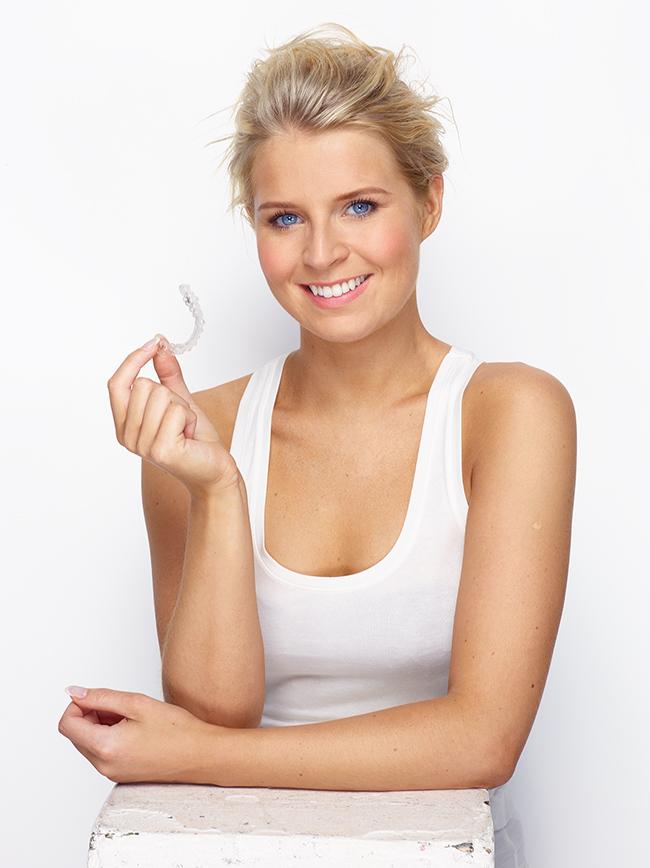
Invisalign® for adults: clear aligners that you take out to eat and wear for 20 to 22 hours a day. Dr. Jaroch has been treating adults with Invisalign® since 2010.
Fixed braces for adults: brackets – tooth-coloured ceramic on request – and a wire that work around the clock without you having to think about wearing times.
Which route is more reliable in your case depends on the planned tooth movements and on your daily routine. We show you both options with their pros and cons – and tell you if a combination makes more sense.
How treatment works
Consultation: you tell us what bothers you and what you would like to achieve.
Diagnostics: digital 3D scan, photos, X-rays if needed, and assessment of gums, bone, bite and jaw joints. More about our digital diagnostics.
Pre-treatment if necessary: gum problems, decay or leaking fillings are treated before braces.
Treatment plan: you see the planned tooth movements on screen and receive a written treatment and cost plan.
Active treatment: fitting of the fixed braces or the first aligners, followed by regular check-ups.
Retention: a retainer secures the result.
How long do braces take for adults?
This depends less on age than on the task. Small corrections, such as aligning a few front teeth, are quicker than a comprehensive bite correction. We discuss duration and costs after the diagnostic work-up.
What do braces for adults cost?
For people with German statutory health insurance, orthodontic treatment from the age of 18 is generally a private service. The insurer pays only in exceptional cases, for example when a severe jaw misalignment is corrected together with jaw surgery. Costs depend on the scope of treatment, the type of brace and the duration; billing follows the German fee scale for dentists (GOZ).
Private health insurance and supplementary dental insurance contribute depending on the policy. So please submit the treatment and cost plan to your insurer before treatment starts. Patients from Switzerland will find everything about travel, billing and documents under Dentist for Swiss patients. For an overview, see Costs & billing.
Making the result last: retention
Teeth have a "memory" and tend to drift back without support – in adults just as in teenagers. After active treatment you therefore receive a fixed retainer on the inside of the front teeth, a removable retainer for the night, or both. Removable retainers are usually worn for many years, sometimes for life at night. We check the retainer at your regular appointments.
Frequently asked questions from adults
Am I not too old for braces at 50?
No. What matters is not age but the condition of your gums and bone. We check both before recommending treatment.
Will people see my braces at work?
Aligners are barely noticeable in conversation. With fixed braces, ceramic brackets are much less conspicuous than metal ones.
Can I wear braces if I have crowns, bridges or implants?
In many cases, yes. During diagnostics we clarify how we include existing crowns, bridges or implants in the planning.
Will treatment be painful?
After fixed braces are fitted or you switch to a new aligner, many people feel pressure for a few days. It usually eases soon.
Request an appointment: request your consultation online – on working days we usually reply within 24 hours.
Which braces should it be?